
Quantum News Daily Roundup by QuantumWay | August 24, 2026

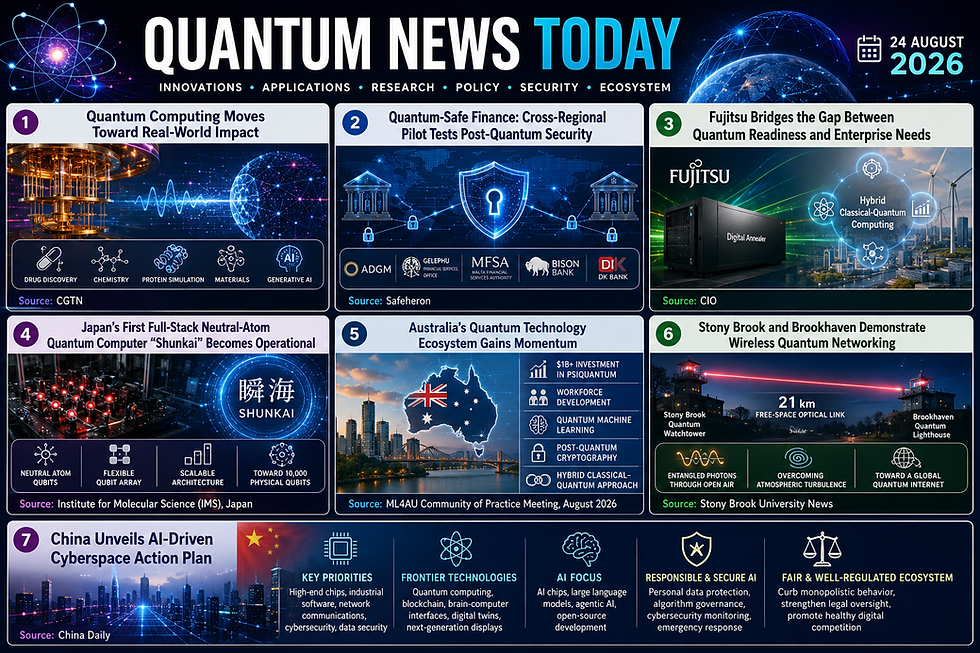
Quantum Computing Moves Toward Real-World Impact
Quantum computing is rapidly moving from theoretical physics toward practical applications, as companies and nations compete to achieve quantum advantage the point at which quantum systems can outperform classical computers on meaningful tasks.
The technology harnesses quantum phenomena such as superposition, allowing qubits to represent multiple possibilities before measurement. The video also highlights photonic quantum computing, with Dr. Richard Murray of ORCA Computing explaining how photons can process information at room temperature, avoiding the extreme cooling required by many competing technologies.
Quantum computers are increasingly viewed as specialized “turbochargers” working alongside classical supercomputers. Promising applications include drug discovery, chemistry, protein simulation, materials science, and generative AI.
The global race is intensifying, with China’s Origin Quantum unveiling the Wukong-180, a 180-qubit superconducting system. While universal quantum computing remains ahead, hybrid quantum-classical systems could become increasingly important by the end of this decade.
Source: CGTN
Quantum-Safe Finance: Cross-Regional Pilot Tests Post-Quantum Security
A new cross-regional pilot led by the Responsible Fintech Institute (RFI), with Safeheron as technology partner, is bringing banks, regulators and technology experts together to test post-quantum cryptography (PQC) for digital asset transactions. The initiative focuses on an MPC-based protocol supporting ML-DSA-65, the NIST FIPS 204 digital signature standard, with testing conducted on the quantum-resistant NEAR testnet. Participants will examine wallet generation, digital asset transfers, interoperability, operational resilience and governance across jurisdictions. Regulators including ADGM, the Gelephu Financial Services Office and Malta Financial Services Authority, alongside banks such as Bison Bank and DK Bank, are participating. The project aims to develop practical guidance for quantum-safe financial infrastructure and eventually open-source its protocol and code for independent scrutiny. A planned whitepaper will document the research, architecture and testing results, supporting broader industry preparedness as quantum computing increasingly challenges conventional public-key cryptography.
Fujitsu Bridges the Gap Between Quantum Readiness and Enterprise Needs
Fujitsu is accelerating enterprise adoption of quantum technologies by combining quantum-inspired computing with its roadmap toward fault-tolerant quantum systems. While commercially viable quantum hardware remains limited by high costs, scarce expertise and demanding operating environments, Fujitsu’s Digital Annealer offers organizations a practical solution today. Running on conventional CPUs and GPUs, the technology can handle optimization problems involving up to 100,000 variables without requiring cryogenic infrastructure. Fujitsu is supporting customers through workshops, trials, proof-of-concepts and commercial deployments, with applications already spanning renewable energy, data-center cooling and drug discovery. The company is also investing in quantum hardware, including a planned 1,024-qubit system, and hybrid platforms that combine classical and quantum computing. Fujitsu argues that this gradual, hybrid approach enables businesses to address complex challenges now while preparing for increasingly capable quantum computers. Its strategy positions quantum-inspired computing as a bridge between today’s enterprise needs and the longer-term quantum future.
Source: CIO
Japan’s First Full-Stack Neutral-Atom Quantum Computer “Shunkai” Becomes Operational
Japan has launched “Shunkai,” its first full-stack neutral-atom quantum computer, developed by Professor Kenji Ohmori’s team at the Institute for Molecular Science (IMS). Operational from August 24, 2026, the system integrates hardware, software, quantum processing, control, and measurement into a complete computing platform.
Shunkai uses atoms trapped by laser-based optical tweezers as qubits, enabling flexible qubit configurations, long quantum-information lifetimes, and potentially scalable quantum computing without the ultra-low temperatures required by superconducting systems. The initial system will operate with approximately 50 qubits, with plans to expand to around 500 qubits.
The project involves collaboration with Hitachi on the software stack and Infleqtion on the quantum processing unit. External researchers will gain access to develop applications and quantum error-correction techniques. By March 2031, the team aims for 10,000 physical qubits with fault-tolerant quantum error detection and correction, potentially positioning Shunkai as a major platform for Japan’s quantum-computing ecosystem.
Australia’s Quantum Technology Ecosystem Gains Momentum
Australia is accelerating efforts to build a globally competitive quantum technology industry, combining major government investment, workforce development and emerging technical applications. The August 2026 ML4AU Community of Practice meeting highlighted the $1 billion investment in PsiQuantum in Queensland, emphasizing that such funding aims to establish a long-term industry, not simply support research.
A major focus is developing a skilled workforce through universities and vocational pathways such as TAFE, helping retain quantum expertise domestically. Speakers also acknowledged current challenges, including noisy hardware, high error rates and the difficulty of achieving fault-tolerant quantum advantage.
Quantum machine learning (QML) is showing potential for high-dimensional, low-sample datasets, with possible applications ranging from traffic optimization for the 2032 Brisbane Games to medical data classification using quantum kernels. The meeting also stressed the urgency of post-quantum cryptography to address future cybersecurity risks. Hybrid classical–quantum approaches, reproducible experiments and shared test beds were identified as important to building confidence and advancing commercialization.
Source: ML4AU Community of Practice Meeting, August 2026
Stony Brook and Brookhaven Demonstrate Wireless Quantum Networking
Researchers at Stony Brook University and Brookhaven National Laboratory have demonstrated a 21-kilometer free-space optical (FSO) link capable of transmitting quantum information through open air. The August 21 milestone marks the first U.S. demonstration of this type and represents a major step toward extending quantum networks beyond fiber-optic cables.
Using laser-generated photons, researchers transmitted quantum states between Stony Brook’s Quantum Watchtower and Brookhaven’s Quantum Lighthouse. Nighttime experiments successfully distributed and detected entangled photons across the wireless link, demonstrating the potential for sustained quantum communication.
The FSO system uses precision optical and telescope technologies to overcome atmospheric turbulence and preserve fragile quantum states. Researchers are now preparing to connect the network to Yale University across Long Island Sound and ultimately to satellites.
The technology could enable distributed quantum computing, advanced sensing, and highly secure communications, helping evolve today’s regional quantum networks toward a global quantum internet.
Source: Stony Brook University News
China Unveils AI-Driven Cyberspace Action Plan
China’s top internet regulator has unveiled an action plan for 2026–2030 aimed at making cyberspace enterprises a stronger driver of high-quality economic and social development by 2030. The plan emphasizes technological innovation, improved products and services, and a secure, well-regulated digital ecosystem. Key priorities include breakthroughs in high-end chips, industrial software, network communications, cybersecurity and data security. Frontier technologies such as quantum computing, blockchain, brain-computer interfaces, digital twins and next-generation displays are also highlighted. Artificial intelligence receives particular attention, with support for high-end AI chips, large language models, agentic AI and open-source development. The plan also stresses responsible AI use, personal data protection, algorithm governance and stronger cybersecurity monitoring and emergency response. Regulators aim to curb monopolistic and disorderly competition while strengthening legal oversight. The initiative is intended to enhance China’s technological capabilities, cybersecurity resilience and global competitiveness.
Source: China Daily


